Topics
ForecastingOperationsDecision systems
Insight
Most forecast failures are operating-system failures. The spreadsheet is usually just where the problem becomes visible.
Forecasts usually fail because the operating system beneath them is weak, not because the chart is missing polish.
Topics
Relevant operating path
Use this path when leaders still rebuild forecasts manually because pipeline, demand, or capacity signals are too inconsistent to support decisions.
Key takeaways
Takeaway 01
Condensed operating implication from the article below.
Takeaway 02
Condensed operating implication from the article below.
Takeaway 03
Condensed operating implication from the article below.
Most companies do not have a forecasting problem because they lack arithmetic. They have a forecasting problem because the operating system underneath the forecast is weak.
The spreadsheet is only where the weakness becomes visible. The real failure usually lives earlier in the chain:
If a leadership team says it does not trust the forecast, that usually means one of two things. Either the process generating the forecast is too manual, or the workflow underneath it is already too inconsistent to support a stable signal.
That is why forecast projects fail when they start with dashboard design. A better chart does not repair the logic of opportunity progression, inventory exposure or exception behavior.
The first useful question is not “what should the forecast look like?” It is “what assumptions are currently being smuggled into the number without enough control?”
Forecast drift is often caused by silent structural issues:
None of those are visualization problems. They are system-design problems.
A stronger forecast usually needs three things:
First, a clearer operating model. Opportunity stages, demand signals or workload assumptions must mean the same thing every time.
Second, a better signal layer. The forecast should reflect real commercial or operational movement instead of a monthly reconstruction exercise.
Third, tighter controls around exceptions. If key reversals happen outside the model, the forecast becomes politically editable rather than structurally useful.
The point of a forecast is not to look sophisticated. The point is to help the business decide earlier and with more confidence.
If the forecast cannot reliably influence inventory, capacity, pricing or commercial follow-up, it is not functioning as a decision system. It is just reporting with extra ceremony.
That is why forecast work belongs next to process design, workflow controls and trust in numbers. Once those are stronger, the forecast stops lying as often because the organization stops asking it to carry assumptions the system never made explicit.
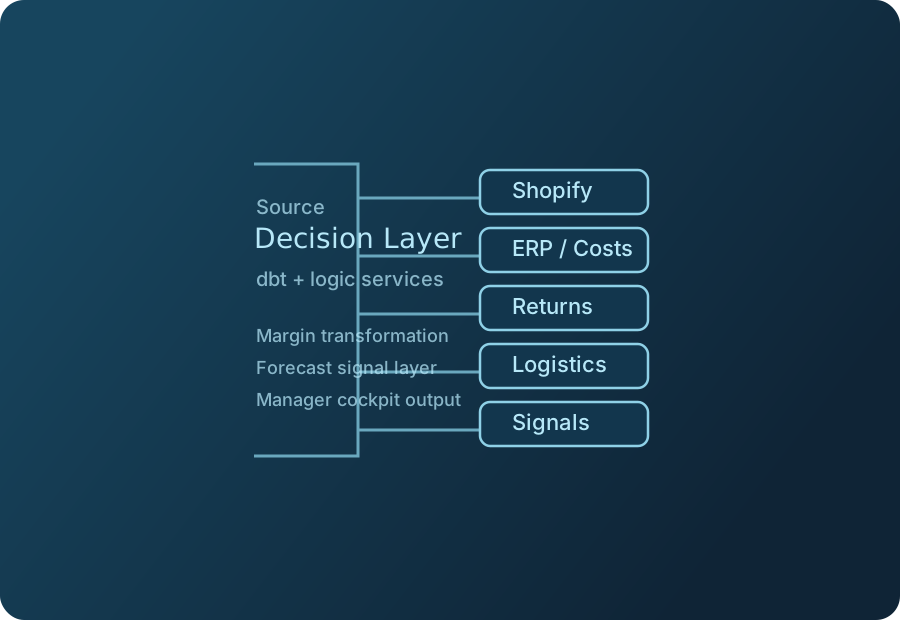
Diagram
Next step
If this article names the friction you already feel, continue into the closest proof project or start the contact flow with that context attached.
Related read
Visibility matters, but chaos usually survives because the workflow underneath it is still weak. Reporting alone cannot repair that.
Related read
Revenue can look healthy while profitability quietly weakens. The leakage usually sits in the places growth makes harder to see.